Hamiltonian Dynamical Systems: Arnold Conjecture

(This is a huge project for me, since some details are even confusing for myself, I’m still a beginner of this field, this blog will be innovated inconstantly. It’s all up to my mood ^_^.)

This is an introductory article to a famous problem appeared in the Hamiltonian Dynamical Systems (and Symplectic topology), the Arnold conjecture, and a brief idea, which originated from Andreas Floer, to prove this conjecture. Let’s first start from the Morse theory.

1 Morse Homology

1.1 General Idea of Marston Morse

From a nowadays perspective of the geometry (probably due to Grothendieck and Serre), studying the geometry of a space X (scheme, variety, manifold, etc.) is equivalent to study the structural sheaf of that space \mathcal{O}_X, in a mjority of the case, that structural sheaf is constructed from analytical aspects, for example, if X is a smooth manifold, it can be completely determined by its ring (or algebra) of smooth functions on X, namely C^\infty(X) , that is to say, the restriction in doing analysis on X is completely due to the geometrical nature of X.

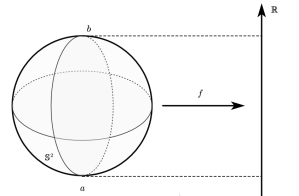
Morse theory is a prior example of this philosophy. Morse’ idea was wishing to use a “Nice” function f: X\longrightarrow \mathbb{R} defined on a smooth manifold X to encode with some certain geometrical or topological properties of X, these nice functions are so called the Morse functions, that is a smooth function f with nondegenerate critical points, for example, the height function of a closed surface:

The height function on \mathbb{S}^2, with 2 critical points on the south and north pole a,b.

It is proved that Morse functions are vastly existed on every compact manifold, hence it is a great tool that can help with the investigation of the topology of that manifold, a well-known application is that a critical point of a Morse function corresponds to a cellular structure of the underlying manifold.

Near each critical point a_i of f, there is a so-called Morse chart (U_i,\phi_i) such that the expression of f under this chart is simply a quadratic form:

\begin{aligned}f\circ\phi^{-1}(x_1,...,x_n)=f(a_i)-\sum_{j=1}^{i}x_j^2+\sum_{j=i+1}^nx_j^2 \end{aligned}

The negative index i of this quadratic form is called the index of this critical point (index is a nonnegative integer), denoted by \mathrm{ind}(a_i) and it is independent of the choice of the Morse charts. Again, as the figure shows above, the critical point a has index 0, and b has index 1.

There is also another (more intuitively) way to find the index of a critical point.

If we impose a Riemannian structure g_x=\langle.,.\rangle_x on X, then we can define the gradient vector field \nabla f of a Morse function f in the following way: for any x\in X and V\in T_x X:

\langle\nabla _xf, V\rangle=(df)_xV

the field \nabla f will induce a flow \phi^t:X\longrightarrow X on X, and if we fix a point x\in X, the flow acting on this point defines a curve \phi^t_x: I\longrightarrow X, this curve is called the gradient flow line of f (hence the flow line flows through a point is uniquely determined), one can show by definition that the function f decreases along the minus gradient flow line:

\begin{aligned}\frac{d(f\circ\phi^t(x))}{dt}=-\|\nabla_{\phi^t(x)}f\|^2\end{aligned}\leqslant 0

And the critical points of the Morse function f are the singularities (zeros) of the gradient field \nabla f. There are two natural definitions arising from here:

\begin{aligned}W^s(a)&=\left\{x\in X | \lim_{t\to\infty}\phi^t(x)=a \right\}\\W^u(a)&=\left\{x\in X|\lim_{t\to-\infty}\phi^t(x)=a\right\}\end{aligned}

They are called the stable and unstable (sub)manifold of the critical point a respectively, intuitively, the stable submanifold consists of the points in X which will flow to a along the gradient flow line, and in contrast, the unstable submanifold consists of the points which be flowed from a. For example, for the height function of \mathbb{S}^2 as illustrated above, the stable submanifold for north pole b is W^s(b)=\{b\}, and the unstable one is W^u(b)=\mathbb{S}^2\setminus\{a\}, now it is not hard to prove (but still challenging for a beginner) the following result:

Theorem 1.1: W^u(a), W^s(a) are open submanifolds of X and they are diffeomorphic to open disks, moreover:

\dim W^u(a)=\mathrm{codim} W^s(a)=\mathrm{ind}(a)

More precisely, the unstable submanifold W^u(a) implies a \mathrm{ind}(a)-cell inside X.

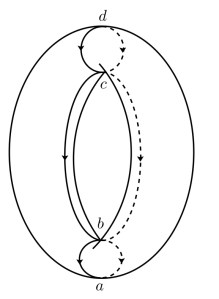
As another example, the following figure shows the critical points of the height function on a torus \mathbb{T}^2, it has 4 critical points a,b,c,d, W^s(a) is the complement of the line ending at b,c.

The gradient flow line flows downwards.

Also, it is not hard to find the gradient flow line flows from high index critical point to the low index one.

1.2 Morse Complex

Although, we know from the homological axiom that all homologies must be equal, but it is still necessary to construct homology functor from different aspects, for they offer us various ways in the comprehension of the object, the simplicial homology came through the simplicial decomposition, the de Rham cohomology came through the analysis on manifold, however, the Morse homology is constructed through a view from dynamical system.

We define the k-th Morse chain group as:

\begin{aligned}C_k(X;\mathbb{Z}_2)=\left\{\left.\sum_{c\in\mathrm{Crit}_kf}n_c.c\right|n_c\in\mathbb{Z}_2\right\}\end{aligned}

That is a free \mathbb{Z}_2-module generated by the critical points of f with index k.

In order to define the boundary map, we need to find the connection between the critical points in successive indices, however, we need to impose an extra hypothesis.

We call a gradient field \nabla f satisfies the Smale condition if for any two critical points a,b of f, W^s(a) intersects transversally with W^u(b), denoted by W^s(a)\pitchfork W^u(b), once if a gradient field satisfies with the Smale condition, one has:

\dim(W^u(a)\cap W^s(b))=\mathrm{ind}(a)-\mathrm{ind}(b)

We denote by \mathcal{M}(a,b) of this intersection, it consists of all points flow (along the gradient flow lines) from a to b:

\begin{aligned}\mathcal{M}(a,b)=\left\{x\in X| \lim_{t\to-\infty}\phi^t(x)=a \bigwedge \lim_{t\to\infty}\phi^t(x)=b\right\}\end{aligned}

The Lie group \mathbb{R} acts by translation (along gradient flow lines) on \mathcal{M}(a,b), that is t.x=\phi^t(x), and it is free precisely if a\neq b, hence we obtained a quotient space \mathcal{L}(a,b)=\mathcal{M}(a,b)/\mathbb{R}, it consists of all gradient flow lines connecting a and b, and we have for its dimension (a smooth manifold since by free Lie group action):

\dim\mathcal{L}(a,b)=\mathrm{ind}(a)-\mathrm{ind}(b)-1

So now, if two critical points are of successive indices, then \mathcal{L}(a,b) is a discrete manifold, hence we can define n(a,b) to be its cardinality modulo 2, and here comes the boundary map:

\begin{aligned}\partial(a)=\sum_{b\in\mathrm{Crit}_{k-1}f}n(a,b).b: C_k\longrightarrow C_{k-1}\end{aligned}

It is pretty not easy to show that:

Theorem 1.2: The following is a chain complex:

...\longrightarrow C_{k+1}\stackrel{\partial}{\longrightarrow} C_k\stackrel{\partial}{\longrightarrow}C_{k-1}\longrightarrow...

Hence it determines a homology group in \mathbb{Z}_2 coefficient H_k(X;\mathbb{Z}_2), and it is independent of choice of the Morse function f.

This homology group is called the Morse homology. Notice that, if we impose an orientation on \mathcal{L}(a,b), we can also use the \mathbb{Z} coefficient, however, we still prefer the \mathbb{Z}_2-coefficient since it is a field, hence we can talk about the dimension of the vector space H_k(X;\mathbb{Z}_2).

It can be proved that the Morse homology has functoriality, hence it has all properties of other homologies, for example, Künneth formula, Poincaré duality, homotopy invariance, etc. Moreover, it is no wonder that the Morse homology coincide with the cellular homology, i.e., there is a natural isomorphism between these two chain complexes.

What a surprising result of the Morse homology is that it can help to evaluate the number of the critical points of a Morse function.

Theorem 1.3 (Morse Inequality): The number of critical points of a Morse function f on a manifold X is at least the sum of dimensions of all homology groups, i.e.:

\begin{aligned}|\mathrm{Crit}(f)|\geqslant \sum_{k=0}^{n}\dim H_k(X;\mathbb{Z}_2)\end{aligned}

Proof: It is obviously that:

\begin{aligned}|\mathrm{Crit}(f)|&=\sum_{k=0}^n\dim \mathrm{Crit}_k(f)=\sum_{k=0}^{n+1}\dim\ker\partial_{k}+\dim\mathrm{Im}\partial_k\\&=\sum_{k=0}^{n}\dim\ker\partial_{k}+\dim\mathrm{Im}\partial_{k+1}\\&\geqslant\sum_{k=0}^{n}\dim\ker\partial_{k}-\dim\mathrm{Im}\partial_{k+1}=\sum_{k=0}^{n}\dim H_k(X;\mathbb{Z}_2) \qquad\blacksquare\end{aligned}

Now, it is appropriate to end the story of Morse theory, right now.

2 Hamiltonian Dynamics

2.1 Hamiltonian Equations

Now we assume our (X,\omega) to be a compact symplectic manifold of dimension 2n. For a smooth (Hamilton) function H: X\longrightarrow \mathbb{R}, there is a “symplectic analogue” of the gradient vector field, called the Hamiltonian vector field X_H associated to the function H:

\omega_x(X_H,V)=-(dH)_xV

for all V\in T_xX, it can also be denoted by \iota_{X_H}\omega=-dH, and likewise, the critical points of H are exactly the singularities (zeros) of Hamiltonian X_H.

The relationship between Hamiltonian vector field and the gradient vector field is subtle. Recall that there is a compatible almost complex structure J on every symplectic manifold, that is a smooth family of linear isomorphisms J_x:T_xX\longrightarrow T_xX, with J_x^2=-\mathrm{Id}, and satisfies with the compatible condition:

\omega_x(Ju,Jv)=\omega_x(u,v)

and \langle u,v\rangle_x:=\omega_x(u,Jv)=\omega_x(-Ju,v) is a Riemannian metric, for all u,v\in T_xX. Through a brief calculation we can find that

X_H=J\nabla H

So, the Hamiltonian field is just a “twisted” gradient field.

The flow of a Hamiltonian is given by the ode:

X_H\circ \phi(t)=\phi'(t)

If we write down in a local Darboux chart (U, (x_i,y_i)), then that ode is just the Hamiltonian equation in Mechanics. Indeed, we can choose a calibrated almost complex structure at each T_xU with the standard matrix representation (under the base \left\{\frac{\partial}{\partial x_i},\frac{\partial}{\partial y_i}\right\}):

J_x=\begin{pmatrix}0& -I_n\\ I_n&0\end{pmatrix}

and assume \phi(t)=(p_1(t),...,p_n(t),q_1(t),...,q_n(t)), hence our ode becomes to:

\begin{aligned}\frac{\partial H}{\partial q_i}=-p_i'\qquad \frac{\partial H}{\partial p_i}=q_i'\end{aligned}

The flow \phi^t of the Hamiltonian X_H is called the Hamiltonian flow, to be distinguished, we shall write this as \phi^t_H, physicists prefer to call this a conservative current, since the Hamilton function H is a constant along the Hamiltonian flow: H\circ \phi^t_H(x)=c, for some c\in \mathbb{R}.

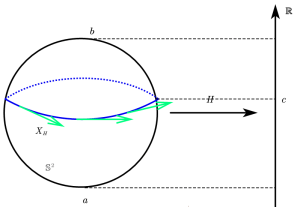
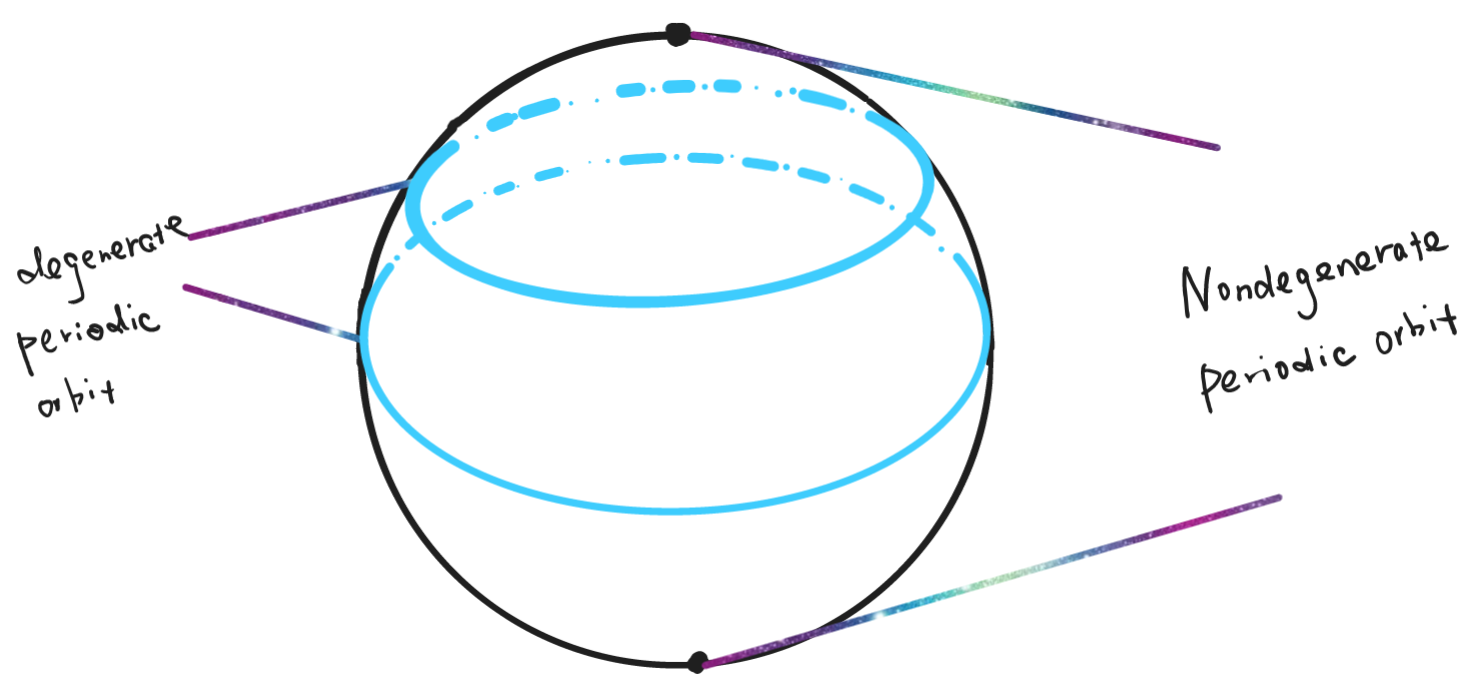
As a simple example, one can consider the height function H (again!) on \mathbb{S}^2, the Hamiltonian vector field X_H is the tangent field of the weft circle, its Hamiltonian flow is just the weft, which is the level set H^{-1}(c) at the height c. (Comparing with the gradient flows, they are meridians.)

The Hamiltonian flows of height function on \mathbb{S}^2 are the wefts

Like the case in the gradient flow (it preserves the Riemannian structure), the Hamiltonian flow preserves the symplectic structure, that is (\phi^t_H)^*\omega=\omega, a symplectomorphism. Also, we shall note that the critical points are exactly the fixed points of the one parameter Lie group \{\phi^t_H|t\in\mathbb{R}\}.

2.2 Periodic Solutions

There is a significant concept in Hamiltonian dynamical systems, that is the periodic orbits/solutions of a Hamiltonian system. An orbit (or I shall say, the Hamiltonian flow line) of the Hamiltonian flow \phi^t_H(x): \mathbb{R}\longrightarrow X is called a periodic orbit (of periodic 1) if \phi^t_H=\phi^{t+1}_H, geometrically, a periodic orbit looks likes some unions of \mathbb{S}^1 (The wefts of a sphere for instance).

It is obviously that the critical points of H are all periodic-1 orbits of the associated Hamiltonian dynamical system, since the orbits of critical points are just a single point, they are identically periodic, and of course, if \phi^t_H(x) is a periodic orbit of periodic 1, then every point in the Hamiltonian flow line is a fixed point of \phi^1_H.

As an analogue in Morse theory, we can also define what is a nondegenerate periodic orbit.

Definition 2.1: A periodic orbit (of periodic 1) \phi^t_H(x) is nondegenerate, if the differential map (d\phi^1_H)_x: T_xX\longrightarrow T_xX does not have 1 as an eigenvalue.

Intuitively, the nondegeneracy of a periodic orbit requires the orbit cannot be “too large”, for if so, we have the subspace T_x\phi^1_H(x) is the eigensubspace subordinate to the eigenvalue 1 of (d\phi^1_H)_x.

Again, in the case of height function of a sphere, the “large wefts” are periodic but degenerate, however, the south and north poles are nondegenerate one, for their tangent subspaces are null.

The relation between nondegenerate periodic orbits and nondegenerate critical points is a little subtle:

Theorem 2.1: If a critical point of H corresponds to a nondegenerate periodic-1 orbit of \phi^t_H, then it is a nondegenerate critical point. Moreover, if the Hamilton function H is sufficiently “C^2-small”, namely, the norm of its Hessian is less than 2\pi, then vice versa.

Proof: For the first statement, by definition, we have for all u,v\in T_xX

\begin{aligned}(d^2H)_x(u,v)&=(d(dH)_x)_uv=-(d\iota_{X_H}\omega_x)_uv\\&=-\left(\mathcal{L}_{X_H}\omega\right)_x(u,v)\qquad\text{(Cartan magic formula)}\\&=\omega_x([X_H, \tilde{v}]_x,u)\end{aligned}

where \tilde{v} denotes the vector field extended by v, if we can show for all v\neq 0, [X_H, \tilde{v}]_x\neq 0, then by the nondegeneracy of \omega_x, the result will be shown.

Indeed, we choose x to be a critical point of H corresponding to a periodic orbit of \phi^t_H of periodic 1, since (d\phi^1_H)_xv\neq v, and (d\phi^0_H)_xv=\mathrm{id}v=v, hence there exists some t\in\mathbb{R} such that \frac{d}{dt}(d\phi^t_H)_xv\neq 0, however, this is (d\phi^t_H)_x[X_H,\tilde{v}]_x\neq 0, as was to be shown.

For the second statement, if we use the local coordinates, the matrix of (d\phi^1_H)_x is the Jacobian, and we have

\mathrm{Jac}_x(\phi^1_H)-I_{2n}=\exp(J_x\mathrm{Hess}_x(H))-I_{2n}

where J_x choose to be a standard calibrated almost complex structure, so, if the norm of \mathrm{Hess}_x(H) is no more than 2\pi, it is obviously nondegenerate. \quad\blacksquare

The existence of periodic orbits is a core and hard question in Hamiltonian dynamical systems, there is a big conjecture associate to this question, which conjectures the lower bound of the number of nondegenerate periodic orbits of a certain Hamiltonian system, that is the Arnold conjecture.

3 From Morse to Arnold

One of the reasons why I want to write this blog is that I want to make us sure why Arnold conjectured so, instead of conjecturing something others. If we know why it may true, this will give us an appropriate motivation to learn the forthcoming materials, such as Floer homology, Maslov index, Fredholm theory, etc.

Combining with section 2.2 and Morse inequality (theorem 1.3), we have the following simple corollary:

Theorem 3.1: We assume all periodic-1 orbits of a Hamiltonian X_H are nondegenerate, then the number of such periodic orbits of the Hamiltonian system on compact symplectic manifold X is greater than \sum_{k=0}^{2n}\dim H_k(X;\mathbb{Z}_2).

Here, our Hamiltonian dynamical system is an autonomous system, which means H does not depend on the time, however, people will care more about the nonautonomous systems, that is to consider a time dependent Hamilton function: H_t: X\times\mathbb{R}\longrightarrow \mathbb{R}, then the Hamilton equation becomes into:

X_{H_t}\circ \phi(t)=\phi'(t)

V.I.Arnold conjectured the following:

Conjecture 3.2 (Hamiltonian Arnold Conjecture): We assume all periodic-1 orbits of a nonautonomous Hamiltonian X_{H_t} are nondegenerate, then the number of all such periodic orbits is at least \sum_{k=0}^{2n}\dim H_k(X;\mathbb{Z}_2).

There is also another more topological version of Arnold conjecture, called the Lagrangian intersection Arnold conjecture:

Conjecture 3.3 (Lagrangian Intersection Arnold Conjecture): Suppose (X,\omega) is a compact symplectic manifold, L\subset X is a Lagrangian submanifold, then for any Lagrangian L_1 which Hamiltonian isotopic and intersects transversally to L, then the intersection number:

\begin{aligned}|L\pitchfork L_1|\geqslant\sum_{k=0}^{2n}\dim H_k(X;\mathbb{Z}_2)\end{aligned}

The conjecture 3.3 implies the conjecture 3.2, however, the Lagrangian intersection one will not be considered in this blog.

Just one more remark about Arnold conjecture 3.2, that is the Hamiltonian H_t can be assumed to be periodic-1, too. Which is

Theorem 3.4 For any non-autonomous Hamiltonian systems X_{H_t}\circ\phi=\phi' we can associate it with a new Hamiltonian X_{K_t}\circ\phi^{\alpha}=\phi^{\alpha} with \phi^{\alpha(1)}=\phi(1) and K_{t+1}=K_t.

Proof Let \alpha be a bump function onto [0,1] and with compact support on [0,1], let \phi^{\alpha}=\phi\circ\alpha, notice that

\begin{aligned}\frac{d\phi^{\alpha(t)}}{dt}&=\frac{d\alpha}{dt}X_{H_{\alpha(t)}}(\phi^{\alpha(t)}(x))\\&=X_{\alpha'H_\alpha}\circ\phi^{\alpha}\end{aligned}

It is obviously that \phi^{\alpha(1)}= \phi(1). Let K_t=\alpha'(t)H_{\alpha(t)}(x), it is clearly that \phi^{\alpha} is the flow of the Hamiltonian associated to K_t, and K_t can be extended to be periodic-1. \qquad\blacksquare

Many mathematicians made their efforts to solve these conjures, it was Andreas Floer who developed a method, called the Floer homology, which is an analogue of the Morse theory in infinite dimensional, and proved both conjectures, the later one is so called the Lagrangian intersection Floer homology. Meanwhile, there are a lot of “particular” version of the Arnold conjecture which can be proved via different theories, for example, Tamarkin and some other mathematicians used the “micro-local sheaf theory” proved the Lagrangian intersection Arnold conjecture for the cotangent bundle T^*X!

Next, we will talk about the Floer homology originated from the Hamiltonian dynamical case.

4. An Approach of Andreas Floer

Since we are focusing on the “loops” inside a symplectic manifold X, we can consider the space of loops instead of the manifold itself, hence we can define

L(X)=\{\gamma:\mathbb{S}^1\longrightarrow X:\gamma\quad \text{smooth}\}

This space endows with a C^\infty topology (open-compact), however, it is not even connected since two non-homotopical loops are lying in different connected components, but our non-degenerate periodic-1 orbits are those homotopical to the trivial ones, so we can the loop space as

\mathcal{L}X:=\{\gamma:\mathbb{S}^1\longrightarrow X:\gamma\quad \text{smooth and homotopical to the trivial loop}\}

Floer’s idea was to do the Morse theory on this loop space \mathcal{L}X, normally, this space is not a finite dimensional manifold but a Banach manifold.

4.1 Loop Space & Action Functional

For loop space \mathcal{L}X, I will not introduce the structure of Banach manifold on it but will introduce the tangent space directly.

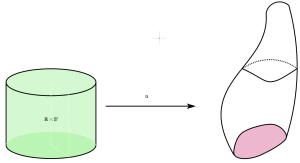
For any loop \gamma(t)\in\mathcal{L}X, to compute the tangent space T_{\gamma(t)}\mathcal{L}X at this point, we can take tangent vectors as those of curves on \mathcal{L}X passing through \gamma, that is u:\mathbb{R}\longrightarrow \mathcal{L}X, we can take this as the map

u:\mathbb{R}\times\mathbb{S}^1\longrightarrow X

with u(0,t)=\gamma(t), hence the tangent vectors are just those \frac{\partial u}{\partial s}|_{s=0}, where u=u(s,t). We can see that a tangent vector at T_\gamma\mathcal{L}X is just a vector field Y(t) on X along \gamma(t), and of course Y(t)=Y(t+1). We’d better make a convention here:

Convention 4.1: (1). For a curve on \mathcal{L}X we refer to be a map u:\mathbb{R}\times\mathbb{S}^1\longrightarrow X.

(2). For a tangent vector in T_\gamma\mathcal{L}X, we refer to be a vector field Y(t) on X along \gamma(t), satisfying Y(t)=Y(t+1)

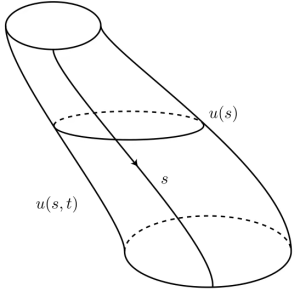
A curve in loop space

Another important notion is about the action functional, which will play an analogy role in Floer homology as Morse functions play in the Morse homology. Let H_t be a time-dependent Hamiltonian function on a symplectic manifold (X,\omega), define

\begin{aligned}\mathcal{A}_H(\gamma(t)):=\int_{0}^1H_t(\gamma(t))dt-\int_{\mathbb{D}}u^*\omega\end{aligned}

to be the action functional on the loop space \mathcal{L}X, where u:\mathbb{D}\longrightarrow X is the extension of the loop \gamma:\mathbb{S}^1\longrightarrow X to the whole disk \mathbb{D}=\{z\in\mathbb{C}||z|\leq 1\}.

Obviously, it is not well-defined since the action functional varies as the extension varies, but if we impose an extra condition \langle\omega, \pi_2(X)\rangle=0, then it dose, since we have

\begin{aligned}\int_{\mathbb{D}}u^*\omega-\int_{\mathbb{D}}u'^*\omega=\int_{\mathbb{S}^2}w^*\omega=0\end{aligned}

where w is defined by gluing of u, u' along their common boundary. Later, our symplectic manifolds will be those with this extra condition.

Next, I will compute the tangent map of this action functional.

Theorem 4.1: We have the tangent map (d\mathcal{A}_H)_\gamma: T_\gamma\mathcal{L}X\longrightarrow \mathbb{R} of the action functional:

\begin{aligned}(d\mathcal{A}_H)_\gamma(Y(t))=\int_{0}^1\omega_{\gamma(t)}(\gamma'(t)-X_{H_t}(\gamma(t)),Y(t))dt\end{aligned}

Proof. To compute the tangent map, we choose a path u:\mathbb{R}\times\mathbb{S}^1\longrightarrow X on \mathcal{L}X, as we discussed before, and passing through \gamma(t) at time s=0, and with tangent \frac{\partial}{\partial s}|_{s=0}=Y(t), to be simplified we will denote this path by u_s(t), and its extension to \mathbb{D} will still be denoted by u_s(t) if there are no ambiguities.

Now, by definition we have:

\begin{aligned}(d\mathcal{A}_H)_\gamma Y&=\left.\frac{\partial}{\partial s}\right|_{s=0}\mathcal{A}_H(u_s(t))\\&=\left.\frac{\partial}{\partial s}\right|_{s=0}\left(\int_0^1H_t(u_s(t))dt-\int_{\mathbb{D}}u_s^*\omega\right)\\&=\int_0^1\left.\frac{\partial}{\partial s}\right|_{s=0}H_t(u_s(t))dt-\int_{\mathbb{D}}\left.\frac{d}{d s}\right|_{s=0}u_s^*\omega\end{aligned}

For first term, by chain rules we have

\begin{aligned}\left.\frac{\partial}{\partial s}\right|_{s=0}H_t(u_s(t))&=(dH_t)_{\gamma(t)}Y(t)\\&=\omega_{\gamma(t)}(Y(t), X_{H_t}(\gamma(t)))\end{aligned}

For second term, by applying Cartan’s magic formula, we have

\begin{aligned}\int_{\mathbb{D}}\left.\frac{d}{d s}\right|_{s=0}u_s^*\omega&=\int_{\mathbb{D}}u_0^*\left(\mathcal{L}_{Y(t)}\omega\right)=\int_{\mathbb{D}}u_0^*\left(d\left(\iota_{Y(t)}\omega\right)\right)\\&=\int_{\mathbb{S}^1}\gamma^*\left(\iota_{Y(t)}\omega\right)=\int_0^1\omega_{\gamma(t)}(\gamma'(t),Y(t))dt\end{aligned}

Combining with all these results, we gain the desired formula, cool! \quad\blacksquare

Now, it is not hard to find the relationship between nondegenerate periodic-1 orbits and critical points of the action functional \mathcal{A}_H:

Theorem 4.2 A loop \gamma\in\mathcal{L}X is a non-degenerate periodic-1 orbit of X_{H_t} if and only if it is a critical point of the action functional \mathcal{A}_H.

So now, we shall be awarded of what we need to play Morse theory on this action functional, here is the table of “menu”:

Morse TheoryFloer Theory
Finite dimensional Manifold XBanach manifold \mathcal{L}X
Morse function f:X\longrightarrow \mathbb{R}Action functional \mathcal{A_H}:\mathcal{L}X\longrightarrow\mathbb{R}
Critical points of fCritical “loops” of \mathcal{A}_H
Morse index of critical pointsMaslov index of critical “loops”
Equation of gradient flowFloer equation
Counting flow lines connecting two critical points with successive indexCounting the number of solutions to Floer equation
Morse homologyFloer homology

Next, I will introduce those analogously notions in Floer theory

4.2 Flow Lines Connecting Two Critical Points

Since for now, the periodic orbits are all critical points of the action functional, just as what we have done in Morse homology, we need to investigate the flow lines connecting them, we first start from the gradient of the action functional.

There is an \omega-tamed Riemannian structure on the symplectic manifold (X,\omega), namely

\langle X,Y\rangle_x=\omega_x(X, J_xY)

for all X,Y\in T_xX, and J is the calibrated almost complex structure, hence it induces a Riemannian structure on \mathcal{L}X, just as we’ve mentioned before, for any X(t),Y(t)\in T_{\gamma}\mathcal{L}X:

\begin{aligned}\langle X(t), Y(t)\rangle_{\gamma(t)}=\int_0^1\omega_{\gamma(t)}(X(t),JY(t))dt\end{aligned}

Now it allows us to define the gradient vector field \nabla_{\gamma}\mathcal{A}_H:

\langle\nabla_{\gamma}\mathcal{A}_H, Y(t)\rangle_{\gamma}=(d\mathcal{A}_H)\gamma Y(t)

Combining with theorem 4.1, we have

Theorem 4.3: We have

\nabla_\gamma\mathcal{A}_H=J_\gamma\gamma'+\nabla_\gamma H_t

Now we can compute the flow line of the minus gradient field, let u:\mathbb{R}\times\mathbb{S}^1\longrightarrow X be a curve (cf. convention 4.1) in \mathcal{L}X, it satisfies with the minus gradient field -\nabla_\gamma \mathcal{A}_H, hence

\begin{aligned}\frac{\partial u}{\partial s}+J_u\frac{\partial u}{\partial t}+\nabla_{u}H_t(u)=0\end{aligned}

This equation is called Floer equation, notice that Floer equation is very similar to Cauchy-Riemann equation, since the first 2 terms is just Cauchy-Riemann equation, with a gradient of H_t redundant.

Recall that we only care about those smooth contractible and periodic-1 solutions in t. Also note that, we didn’t know whether Floer equation has a solution yet.

……

The solution of Floer equation is a surface connecting two critical loops

Next, we will introduce the index of these critical “loops”, they are materials to make Floer chain groups, and how to count the number of the solutions of Floer equation, they are materials to make Floer boundary map.

5 Reference

  1. Michèle Audin, Morse Theory and Floer Homology, Springer-Verlag.
  2. V.I. Arnold, On a Topological Property of Globally Canonical Maps in Classical Mechanics, 1965
  3. C. Viterbo, An Introduction to Symplectic Topology Through Sheaf Theory

留下评论