Dedicated to Lin-Fang Hou, Wen Shen, Zheng-Tong Xie, Jing-Hong Deng, Hong-Jie Chow, Sang-Hao Xing and Jia Fei
In a memory to the fear during the past times provided by the reading seminar on M. Audin’s book.
The characteristic variety of a manifold is the moduli space of representations of the fundamental group into , from Riemann-Hilber correspondence, we know it parametrized the moduli space of flat connections on . The moduli space contains very important topological information of , and it plays a significant role in gauge theory, algebraic geometry and low-dimensional topology. This blog will give some simple examples of characeristic varieties on Riemann surfaces
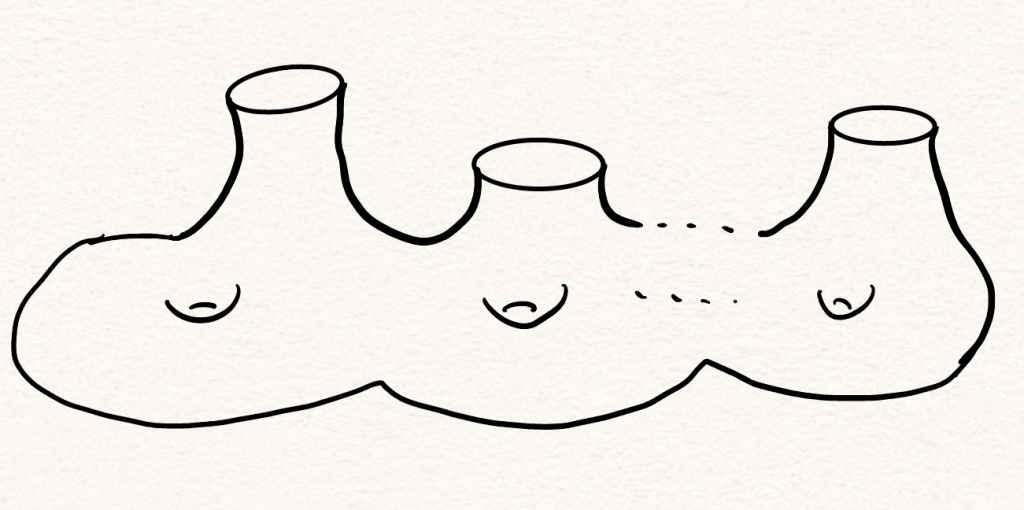
Let be a Riemann surface with genus and boundaries. Topologically, it looks likes the following:
Let’s pick a compact Lie group , the Riemann-Hilbert correspondence told us the following:
Theorem (Riemann-Hilbert): The space of pairs , where is a principal bundle over and is a flat connection, modulo the gauge equivalence is isomorphic to the characteristic variety of :
Sketch of the proof. For a flat connection , the holonomy defined by (a valued 1-form on ) is a representation:
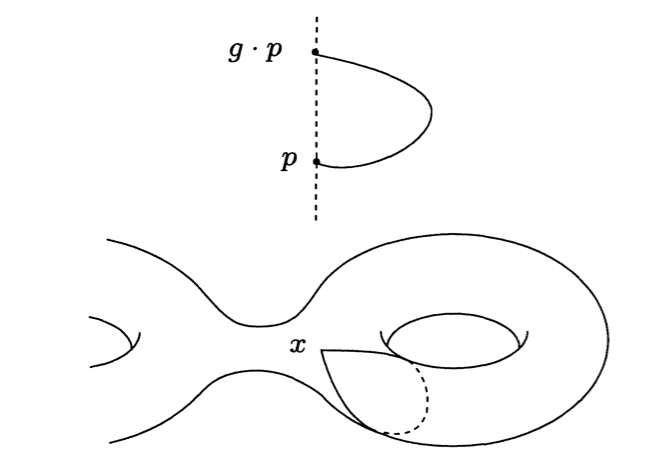
for a loop based at , the holonomy is defined as follows: consider a horizental lift of to , where , at other points it satisfies an ODE:
the holonomy is simply the fiber of .
Horizental lift
To construct the reverse side, let’s consider the universal cover of , then every representation defines a principal -bundle:
where the fundamental group acts by Deck transformation on the universal cover and acts by on . Consider a trivial connection defined on the trivial bundle , it is a pull-back (injection!) of a connection on , one can check that this is flat with holonomy provided by .
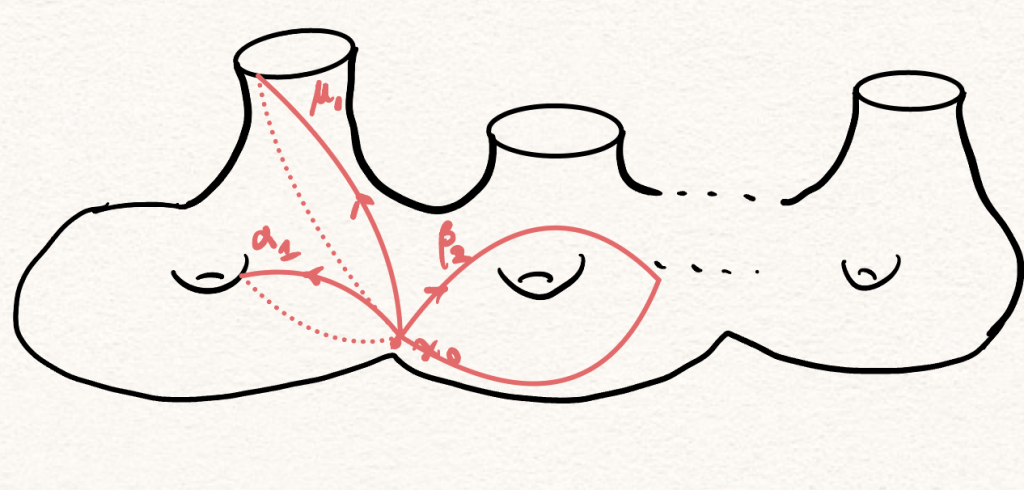
Recall that, the fundamental groups of Riemann surfaces have presentations in words. Let be the oriented loops which touch the boundaries, and be the meridians and wefts based at , then we have
the fundamental group
where is the commutator.
Therefore, the space of representations will be
It is subspace of . Recall the fact that every compact Lie group is an affine smooth real algebraic variety (Hilbert’s 5th problem), therefore, the space is hypersurface, in general, it is a singular real algebraic variety, and after the quotient of the adjoint action of , the characteristic variety is a singular quotient variety.
However, if we are lucky that is smooth, the characteristic variety will still have singularities, where the singularities are provided by the non-free point of the adjoint action.
Notice that, a representation is non-free if and only if there exits a non-trivial such that , hence is not an irreducible representation. Which is to say, the possible singularities are provided by the reducible representations. Moreover, at each regular point, the dimension of can be computed by the dimension of the tangent space, it is:
Here are 2 simple examples:
Example 1: Let which is an Abelian Lie group, thus the adjoint action is just trivial, and the characteristic variety is just . It is:
which is isomorphic to the torus for , and when .
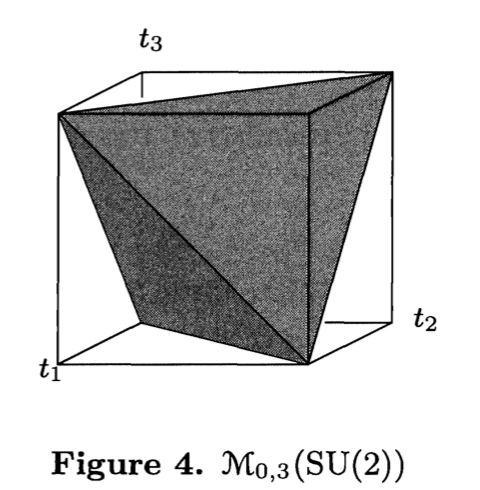
Example 2: Let’s consider a 3-holed sphere , and let . We have
Recall that a matrix is adjoint to a diagonal one . So, under the adjoint action, we can write , where .
Now, to preserve the diagonality of , we can keep using a diagonal elemnt to act on . Under this setting, will have a simple form , where is real positive. Or more techniquely, we can assume for some , and for some .
Finally, since , we can determine the eigenvalues (adjoint type) of , we can assume
Then and should satisfiy the relation
Thus the moduli space can be parametrized by those which satisfies the above trignometric equation.
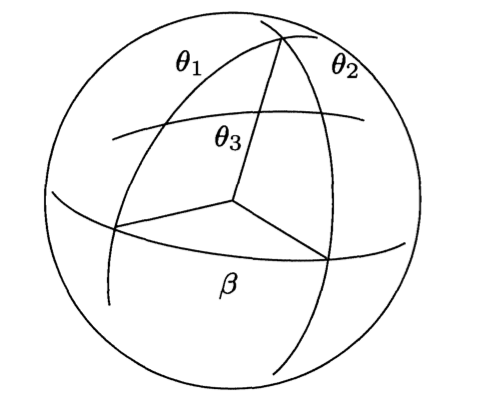
Recall that in shperical geometry, the above equation is the Cosine Formula of a spherical triangle, where are the length of edges of a spherical triangle, and is the angle determined by :
spherical triangle
So, the characteristic variety can be understood as the isometry classes of spherical triangles on a unit sphere , the singularities are where the triangle degenerates. On the other hand, we can send
,
By triangle axioms, we have is isomorphic to the following tetrahedron:
it looks likes the following:
Moreover, the singularities of are precisely the vortices and edges of this tetrahydron, such a space is called a cornered manifold.
Example 3: In the case , and , the characteristic variety is very important in conformal geometry. The component containing discrete representations (i.e. the image is a discrete subgroup of ) forms a connected component, it is the famous Teichmüllerspace of the Riemann surface. It is isomorphic to the Euclidean space . The Teichmüller space will tell the deformation of the hyperbolic structures on . If we replace by some more general Lie group, such as , there is also a special component in the characteristic variety , which is called the Hitchin component. It is referred to a high analogue of the Teichmüller theory, namely, the higher Teichmüller theory.
More interesting things will happen on the characteristic variety. If we assume is simply connected, for example , then every princple bundle over is trivial. So we can fix a principal bundle , and the characteristic variety is the affine space of flat connections on modulo the gauge equivalence: , where is the bundle transformation of , in this case, it is .
In 1982, Atitah and Bott gave a symplectic description of the moduli space . We shall first consider the affine space of connections , its tangent space is just , the valued 1-forms on . There is a natrual symplectic form on :
the term in the integrand can be understood as the Killing form on the Lie algebra .
In the case when , i.e. the Riemann surface has no boundaries, then Atiyah-Bott showed that acts in a Hamiltonian fashion on the symplectic affine space , and the the moment map is simply the curvature: , thus the moduli space of flat connections is the symplectic reduction hence a symplectic manifold.
If the surface has boundaries, then the symplectic structure on cannot induce a symplectic structure on but a Poisson structure. The symplectic leaves are constructed by fixing holonomies along the boundaries. What’s more, in 1984, William Goldman construced an integrable system on the moduli space which is now called the Goldman system.
However, the exciting things are far from over. In the case of compact Riemann surfaces, the characteristic variety earned more investigation, especially for its relation to the gauge theorotical equations. In 1987, Nigel Hitchin introduced the notion of Higgs bundles , which is the solution of the Hitchin’s equations. Hitchin proved the solutions of his equations are gauge equivalent to the stable holomorphic Higgs bundles, hence they can be related to the characteristic variety . Hitchin also constructed an integrable system, which is the celebrated Hitchin’s system, it plays an important role in understanding some other typical integrable systems, and it also shed its light in geometric Langlands Program.




![\tilde{\gamma}: [0,1]\longrightarrow P](https://s0.wp.com/latex.php?latex=%5Ctilde%7B%5Cgamma%7D%3A+%5B0%2C1%5D%5Clongrightarrow+P&bg=ffffff&fg=444444&s=0&c=20201002)




![\begin{aligned}\pi_1(\Sigma_{g,d},x_0)=\left\langle\mu_1,...,\mu_d,\alpha_1,...,\alpha_g,\beta_1,...,\beta_g\left|\prod_{i=1}^d\mu_i\prod_{j=1}^g[\alpha_j,\beta_j]=1\right\rangle\right.\end{aligned}](https://s0.wp.com/latex.php?latex=%5Cbegin%7Baligned%7D%5Cpi_1%28%5CSigma_%7Bg%2Cd%7D%2Cx_0%29%3D%5Cleft%5Clangle%5Cmu_1%2C...%2C%5Cmu_d%2C%5Calpha_1%2C...%2C%5Calpha_g%2C%5Cbeta_1%2C...%2C%5Cbeta_g%5Cleft%7C%5Cprod_%7Bi%3D1%7D%5Ed%5Cmu_i%5Cprod_%7Bj%3D1%7D%5Eg%5B%5Calpha_j%2C%5Cbeta_j%5D%3D1%5Cright%5Crangle%5Cright.%5Cend%7Baligned%7D&bg=ffffff&fg=444444&s=0&c=20201002)
![[\alpha_j,\beta_j]=\alpha_j\beta_j\alpha_j^{-1}\beta_j^{-1}](https://s0.wp.com/latex.php?latex=%5B%5Calpha_j%2C%5Cbeta_j%5D%3D%5Calpha_j%5Cbeta_j%5Calpha_j%5E%7B-1%7D%5Cbeta_j%5E%7B-1%7D&bg=ffffff&fg=444444&s=0&c=20201002)
![\begin{aligned}\mathrm{Hom}(\pi_1(\Sigma_{g,d});G)=\left\langle M_1,...,M_d,A_1,...,A_g,B_1,...,B_g\left|\prod_{i=1}^dM_i\prod_{j=1}^g[A_j,B_j]=1\right\rangle\right.\end{aligned}](https://s0.wp.com/latex.php?latex=%5Cbegin%7Baligned%7D%5Cmathrm%7BHom%7D%28%5Cpi_1%28%5CSigma_%7Bg%2Cd%7D%29%3BG%29%3D%5Cleft%5Clangle+M_1%2C...%2CM_d%2CA_1%2C...%2CA_g%2CB_1%2C...%2CB_g%5Cleft%7C%5Cprod_%7Bi%3D1%7D%5EdM_i%5Cprod_%7Bj%3D1%7D%5Eg%5BA_j%2CB_j%5D%3D1%5Cright%5Crangle%5Cright.%5Cend%7Baligned%7D&bg=ffffff&fg=444444&s=0&c=20201002)


![\theta_1\in[0,\pi]](https://s0.wp.com/latex.php?latex=%5Ctheta_1%5Cin%5B0%2C%5Cpi%5D&bg=ffffff&fg=444444&s=0&c=20201002)


![\beta\in [0,\pi]](https://s0.wp.com/latex.php?latex=%5Cbeta%5Cin+%5B0%2C%5Cpi%5D&bg=ffffff&fg=444444&s=0&c=20201002)

![\theta_2\in[0,\pi]](https://s0.wp.com/latex.php?latex=%5Ctheta_2%5Cin%5B0%2C%5Cpi%5D&bg=ffffff&fg=444444&s=0&c=20201002)






 My Tiny Math Home